GPS Tracking Related
The Future of Auto Insurance is Here: Unlocking Profitability with Pay-As-You-Drive (PAYD) Telematics
Mar
The automotive insurance industry is undergoing a seismic shift. For decades, underwriting was based on static demographic variables—age, gender, marital status, credit score, and zip code. While statistically significant, these proxies for risk are inherently flawed. They fail to account for the most crucial variable in vehicular risk: how, when, and where a vehicle is actually being driven.
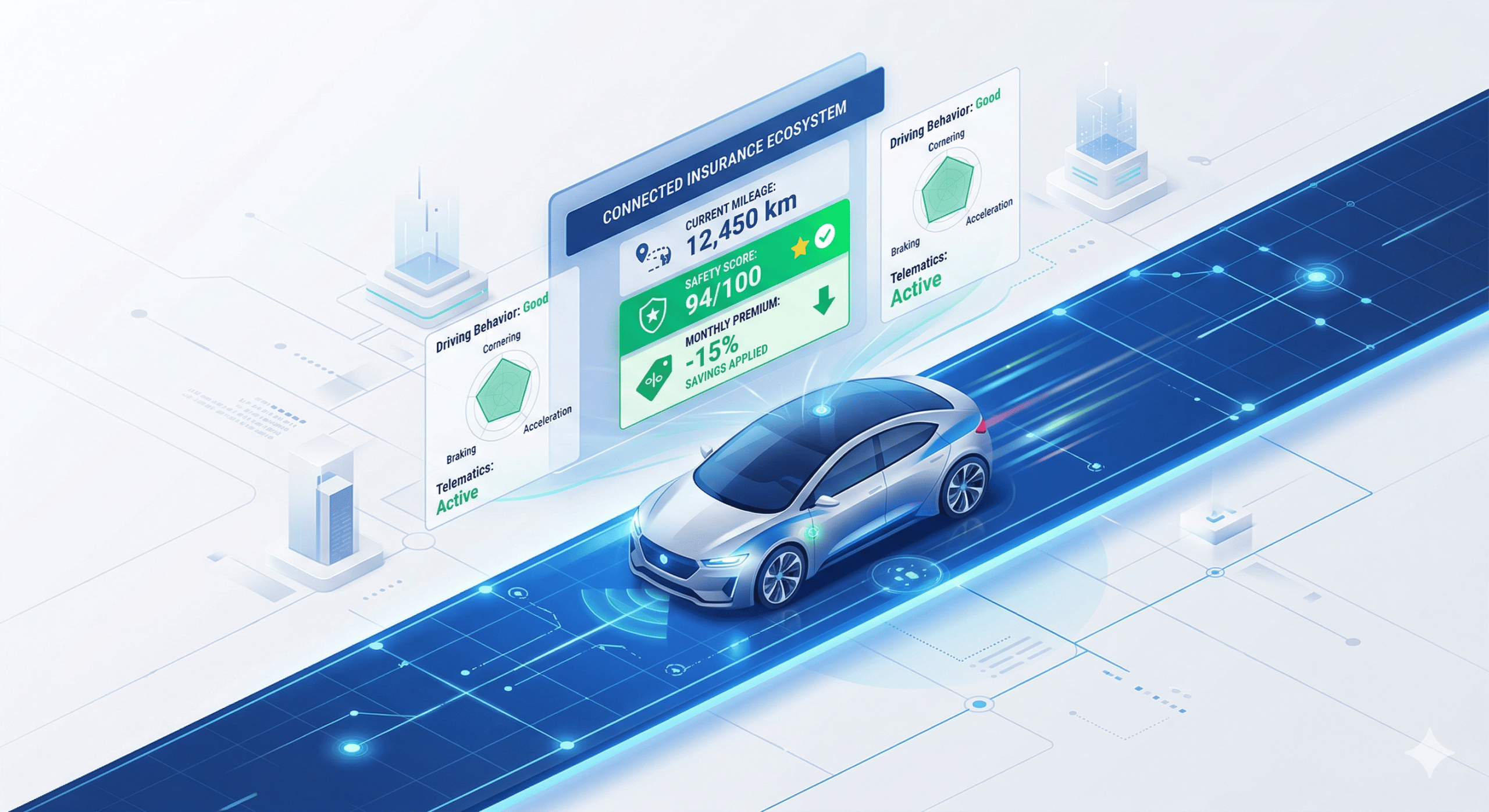
Enter Pay-As-You-Drive (PAYD) and Usage-Based Insurance (UBI).
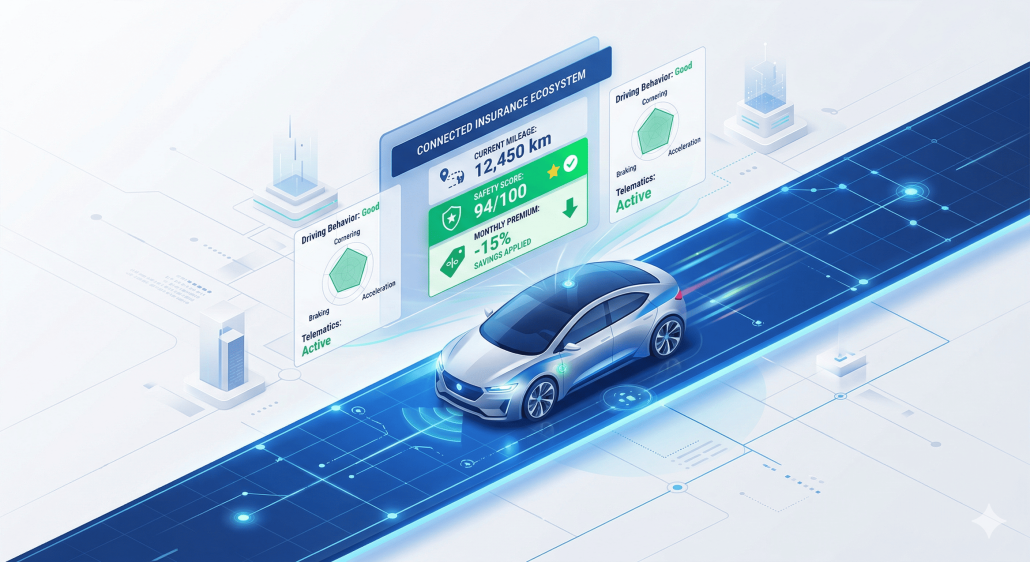
Driven by advanced GPS tracking and telematics software, PAYD is revolutionizing the insurance landscape. It replaces estimations with hard data, enabling insurance providers to price premiums based on actual driving behavior and mileage. At TrackerWay, we are at the forefront of this transformation, providing the robust SaaS infrastructure and reliable hardware required to seamlessly integrate telematics into modern insurance operations.
In this comprehensive guide, we will explore the mechanics of Pay-As-You-Drive insurance, the profound benefits it offers to both insurers and policyholders, the key metrics tracked, and how your insurance company can leverage TrackerWay’s ecosystem to launch a highly profitable UBI program.
What is Pay-As-You-Drive (PAYD) Insurance?
Pay-As-You-Drive (PAYD), often used interchangeably with Usage-Based Insurance (UBI) or Pay-How-You-Drive (PHYD), is an auto insurance model where premium costs are dynamically tied to vehicle usage.
Instead of a flat annual or monthly fee, premiums are calculated using telematics data collected directly from the insured vehicle. This data is transmitted in real-time to a centralized cloud platform—like TrackerWay—where it is processed, analyzed, and formatted for underwriting and claims management teams.
There are two primary models within this ecosystem:
-
Mileage-Based (PAYD): The premium is based primarily on the distance driven. “If you drive less, you pay less.”
-
Behavior-Based (PHYD): The premium is adjusted based on driving habits, including speed, braking patterns, cornering aggression, and the time of day the vehicle is operated.
By transitioning to a telematics-based model, insurance companies can transition from reactive claims handlers to proactive risk managers.
The Mechanics: How Telematics Power the PAYD Ecosystem
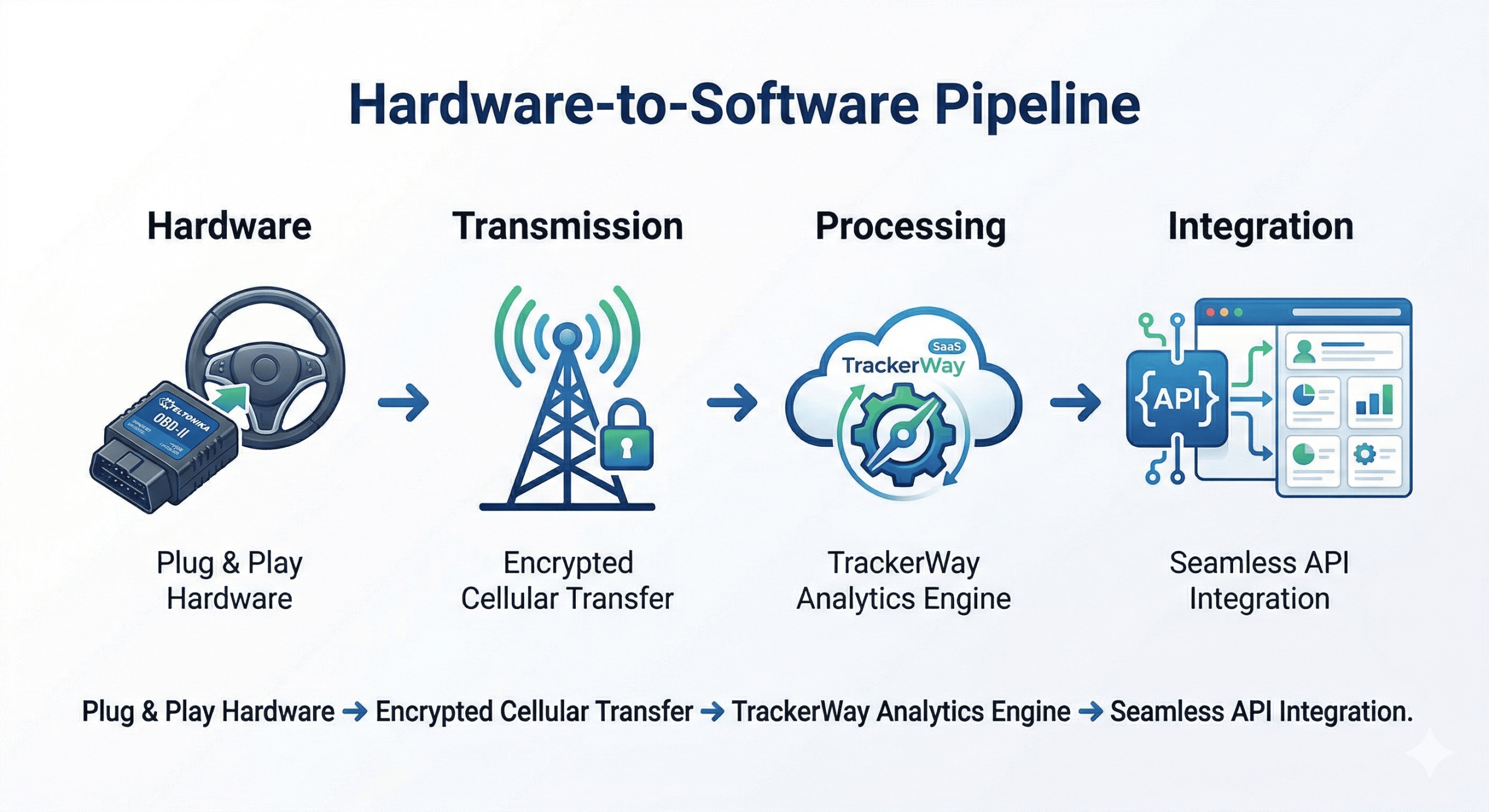
To implement a successful PAYD program, insurers need a seamless hardware-to-software pipeline. Here is how the technology works in practice.
1. The Hardware: Capturing the Data
Data collection begins at the vehicle level. At TrackerWay, we partner with industry-leading hardware manufacturers like Teltonika Telematics to provide highly reliable, easy-to-install tracking devices. For PAYD programs, the most popular solutions are:
-
OBD-II Dongles (e.g., Teltonika FMC003 or FMB003): These are plug-and-play devices that the policyholder can easily plug directly into their vehicle’s On-Board Diagnostics port. It requires zero technical expertise, drastically reducing customer onboarding friction.
-
Hardwired Trackers: Installed securely behind the dashboard, these are ideal for high-value vehicles, commercial fleets, or regions with high theft rates.
-
Bluetooth/BLE Sensors: Additional sensors can be paired with the tracker to ensure the authorized driver is behind the wheel, further preventing fraud.
2. The Software: Processing and Analytics
Once the hardware is active, it begins transmitting encrypted data over cellular networks (2G/4G/LTE/Cat-M1) to the TrackerWay SaaS platform. Our servers process millions of data points, translating raw GPS coordinates and accelerometer data into actionable business intelligence.
3. The API: Seamless Integration with Insurtech Systems
Insurance companies do not need to overhaul their existing IT infrastructure. TrackerWay provides robust RESTful APIs that push telematics data directly into the insurer’s CRM, billing, and underwriting systems. This allows for automated premium adjustments, automated claims initiation in the event of a crash, and streamlined customer communication.
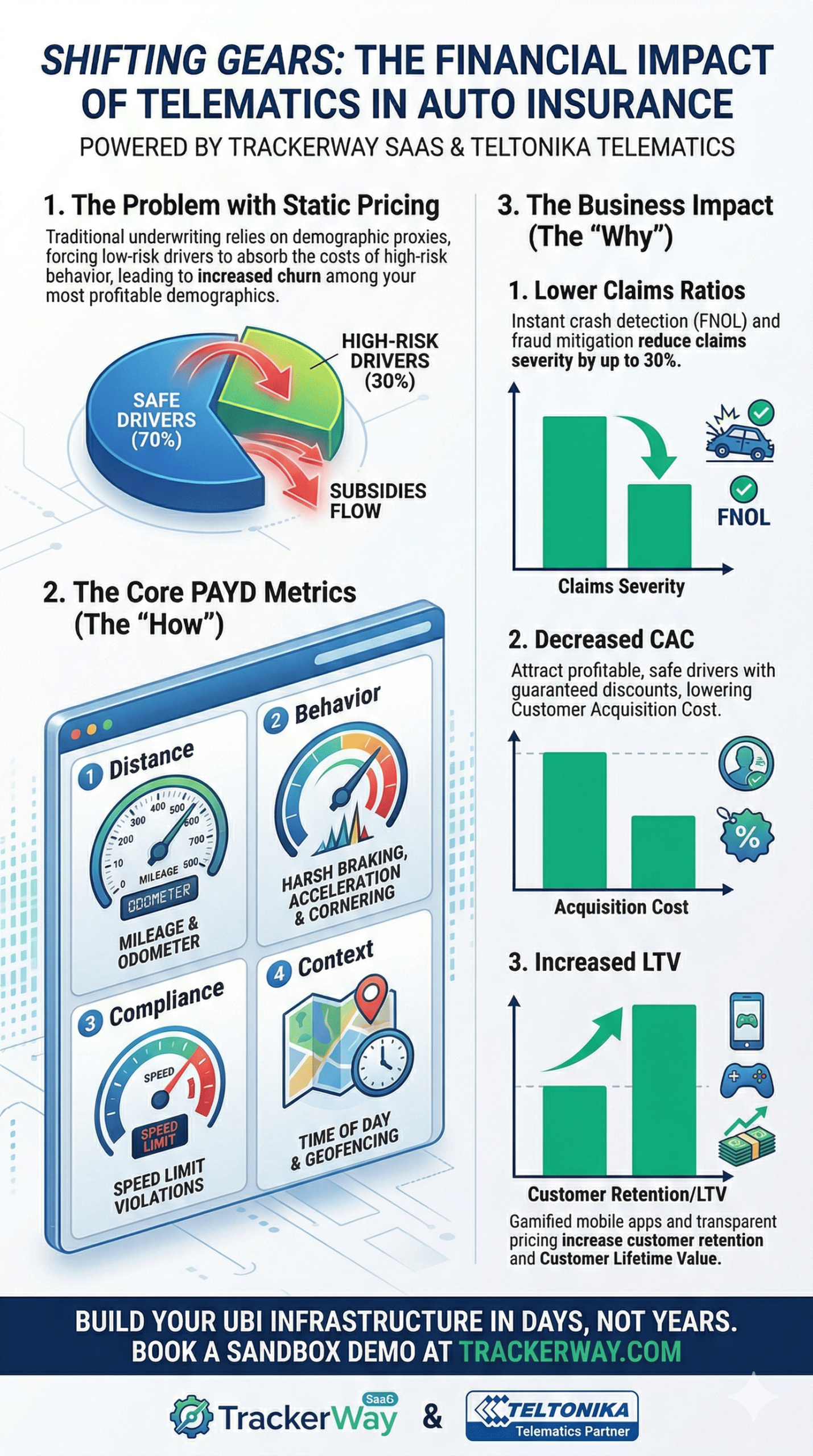 Core Telematics Metrics Tracked for Insurance Underwriting
To accurately assess risk, our GPS tracking software captures a comprehensive suite of driving metrics. These data points allow actuaries to build highly accurate risk models.
1. Mileage and Odometer Tracking
The most fundamental metric of PAYD. Statistical data universally shows that fewer miles driven equates to a lower probability of an accident. TrackerWay provides absolute precision in distance calculation, ensuring that low-mileage drivers—such as remote workers or retirees—are accurately billed.
2. Harsh Driving Behavior (Green Driving)
Accelerometers inside the GPS trackers detect G-force changes to monitor driver behavior. We track:
-
Harsh Acceleration: Rapidly gaining speed, indicative of aggressive driving.
-
Harsh Braking: Sudden stops, suggesting tailgating or inattentive driving.
-
Harsh Cornering: Taking turns at unsafe speeds, increasing the risk of rollovers or loss of control. By scoring these events, insurers can reward safe drivers with discounts or apply surcharges to high-risk individuals.
3. Overspeeding
Speed limits are mapped globally within the TrackerWay system. Insurers receive alerts and historical reports indicating how often, and by how much, a driver exceeds posted speed limits. Prolonged overspeeding is a leading indicator of catastrophic claims.
4. Time of Day and Location Data
Driving at 2:00 AM on a Saturday carries a statistically higher risk than driving at 2:00 PM on a Tuesday due to reduced visibility, fatigue, and the prevalence of intoxicated drivers. Furthermore, geo-fencing features allow insurers to see if a vehicle is primarily garaged in a high-crime area or frequently driven in high-density urban traffic versus rural roads.
5. Crash Detection
Using advanced algorithms, Teltonika devices can instantly detect the severe G-force impact of a collision. The TrackerWay platform immediately logs the event, capturing the exact location, speed at impact, and direction of force. This allows insurers to initiate the First Notice of Loss (FNOL) process instantly, dispatch emergency services if necessary, and combat fraudulent claims.
The Strategic Benefits for Insurance Companies
Transitioning to a UBI model is not merely a technological upgrade; it is a strategic necessity in an increasingly competitive market. Here is why adopting a PAYD model via TrackerWay significantly boosts your bottom line.
1. Radically Improved Risk Assessment and Pricing
Static pricing models result in low-risk drivers subsidizing the costs of high-risk drivers. With PAYD, underwriting becomes an exact science. You can price policies to the exact decimal of risk an individual presents, protecting your profit margins.
2. Significant Reduction in Claims Costs and Fraud
Fraudulent claims cost the auto insurance industry billions annually. “Crash for cash” scams, exaggerated injury claims, and disputes over liability are mitigated by telematics. When a crash occurs, TrackerWay provides the “black box” data: pre-crash speed, braking timeline, and impact severity. If the data does not match the driver’s story, the claim can be confidently contested. Furthermore, knowing they are being monitored inherently alters driver behavior (the Hawthorne effect), leading to a measurable reduction in accident frequency.
3. Enhanced Customer Acquisition and Retention (Lower CAC, Higher LTV)
The modern consumer demands personalization and fairness. Low-mileage and safe drivers actively seek out PAYD policies because it saves them money. By offering a telematics-based policy, you attract the most profitable demographic of drivers—the safe ones. Furthermore, gamifying the experience (e.g., providing drivers an app with a “Safe Driving Score” and monthly discounts) drastically increases customer engagement and retention, maximizing Customer Lifetime Value (LTV).
4. Streamlined Claims Processing (FNOL)
The First Notice of Loss is historically a manual, slow, and expensive process. With automated crash detection, the claims process begins seconds after an impact. Insurers can proactively contact the policyholder, arrange towing, and direct the vehicle to an in-network repair shop, significantly reducing administrative overhead and secondary costs (like long-term storage fees).
5. Stolen Vehicle Recovery
In the event of theft, the TrackerWay platform provides real-time location data, enabling rapid collaboration with law enforcement to recover the asset before it is damaged or stripped for parts. This directly prevents total-loss payouts.
The Benefits for the End-Consumer (Policyholders)
To successfully market a PAYD program, insurance companies must highlight the value proposition to the consumer. TrackerWay’s white-label mobile applications make this easy.
-
Cost Savings: The most significant driver of consumer adoption. Safe, low-mileage drivers can save anywhere from 10% to 40% on their annual premiums.
-
Fairness and Transparency: Consumers are tired of rate hikes caused by the collective behavior of others. PAYD puts the power of pricing directly into the policyholder’s hands.
-
Safety and Peace of Mind: Automated crash detection means that if a driver is incapacitated in an accident, their insurer can automatically dispatch emergency medical services to their exact GPS location.
-
Teen Driver Monitoring: Parents of teenage drivers love PAYD programs. The associated mobile app allows parents to monitor their teen’s driving habits, speed, and location, fostering safer driving habits early on.
-
Vehicle Diagnostics: Through OBD-II trackers, the system can read engine fault codes (Check Engine Light). The app can alert the driver to a mechanical issue before it results in a costly breakdown.
Overcoming Common Challenges & FAQs
Privacy is the primary concern for consumers. Transparency is the solution. Telematics data must be strictly governed by privacy policies (such as GDPR in Europe). TrackerWay ensures end-to-end data encryption and strict role-based access controls. Insurers can structure their programs as “Opt-In” only, clearly explaining that the data is used strictly for premium calculation and claims handling—not sold to third parties. Market data shows that when consumers are offered a guaranteed discount for opting in, the adoption rate is overwhelmingly high.
Not anymore. Historically, hardwiring GPS trackers required professional mechanics, making customer acquisition costs (CAC) prohibitively high. Today, Teltonika OBD-II dongles are shipped directly to the customer’s home. The customer plugs the device into their vehicle’s diagnostic port in under 30 seconds. TrackerWay’s system automatically detects the new device and provisions it to their account instantly.
You don’t have to. TrackerWay acts as the data processing engine. We do not dump millions of raw GPS coordinates onto your servers. Instead, our software aggregates the data and pushes clean, actionable metrics (e.g., “Driver A: 500 miles driven this month, Safety Score 92/100, 2 Harsh Braking Events”) to your system via API.
Teltonika OBD-II trackers feature built-in disconnect alerts. If a policyholder unplugs the device—whether to hide a long trip or mask aggressive driving—the TrackerWay platform immediately flags the event and notifies the insurer. Insurers can then automate a policy rule, such as reverting the driver to a standard, non-discounted premium rate until the device is reconnected.
Why Partner with TrackerWay for Your Telematics Initiative?
Building a telematics infrastructure from scratch is a multi-million-dollar endeavor that takes years of development, testing, and compliance auditing. TrackerWay offers a ready-to-deploy, white-label SaaS ecosystem designed for scalability.
-
Pioneer SaaS Technology: Our platform currently handles thousands of clients and millions of data points globally. With an uptime of 99.99%, we offer enterprise-grade reliability.
-
Hardware Agnostic, but Teltonika Optimized: While our platform supports over 800 tracker models, we are official partners with Teltonika Telematics, ensuring the deepest possible integration with the world’s most reliable hardware.
-
White-Label Branding: The software and mobile apps your clients use will feature your insurance company’s logo, color scheme, and branding. TrackerWay operates silently in the background.
-
Dedicated Support: With 7 global offices and 24/7 technical support, our team acts as an extension of your own IT department.
Conclusion: The Future is Data-Driven
The era of estimating risk is over. The insurance providers that thrive over the next decade will be those who harness the power of IoT, telematics, and big data to offer personalized, fair, and profitable products.
Pay-As-You-Drive is not just a marketing gimmick; it is a fundamental restructuring of the auto insurance P&L. It lowers claims severity, eliminates fraud, attracts high-value customers, and increases operational efficiency.
Are you ready to modernize your insurance offerings? Contact the enterprise solutions team at TrackerWay today to schedule a tailored demonstration of our UBI and Pay-As-You-Drive platform architectures. Let us help you build the future of your insurance business.
